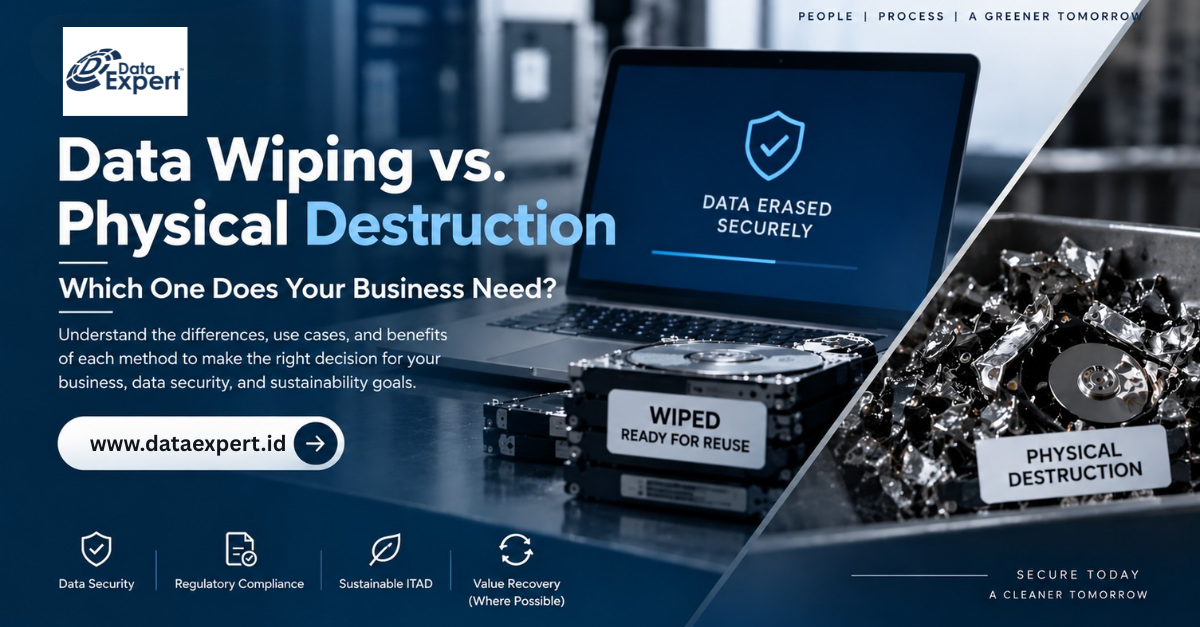
Data wiping vs physical destruction is an important decision when IT assets reach the end of their lifecycle. Choosing the right method can affect data security, compliance, sustainability, and asset value recovery.
What Happens to Data When an IT Asset Reaches End-of-Life?
When laptops, servers, hard drives, SSDs, and other IT assets reach the end of their operational lifecycle, disposing of the hardware is only part of the process.
The data stored on those devices must also be managed securely.
Simply deleting files, formatting a drive, or performing a factory reset may not provide an appropriate level of data sanitization for business environments. Organizations should select a sanitization method based on the type of storage media, its condition, internal security requirements, and what will happen to the asset afterward.
Two common approaches are data wiping and physical destruction.
Although both can form part of a secure IT Asset Disposition (ITAD) strategy, they serve different purposes.
What Is Data Wiping?
Data wiping is a software-based sanitization process designed to securely remove data from a storage device while allowing the device to remain usable where technically appropriate.
Unlike ordinary file deletion, professional data wiping uses controlled processes to sanitize data and provide verification that the operation has been completed.
At DataExpert, data wiping can form part of a documented IT asset disposition process, including asset identification, serial number recording, processing, verification, and reporting.
When Does Data Wiping Make Sense?
Data wiping can be appropriate when storage devices are functional and the organization intends to:
- Redeploy equipment internally
- Reuse functional IT assets
- Remarketing or resell eligible equipment
- Participate in an IT asset buyback program
- Reduce unnecessary electronic waste
- Preserve the remaining value of retired IT assets
This makes data wiping particularly valuable for organizations looking to balance data security with sustainability and asset value recovery.
Instead of automatically destroying every functional device, securely sanitized equipment may be given a second lifecycle where organizational policy permits.
What Is Physical Destruction?
Physical destruction is the process of permanently damaging storage media so that the device can no longer function as originally intended.
Depending on the media and security requirement, this can include methods such as HDD shredding, SSD shredding, drilling, or other controlled physical destruction processes.
Physical destruction may be appropriate when:
- The storage media is damaged or no longer functional
- The device has no reuse or resale value
- Organizational policy requires physical destruction
- The media contains highly sensitive information and reuse is not permitted
- The asset has reached its final end-of-life stage
After destruction, the resulting material should be handled through an appropriate downstream recycling process.
What About Degaussing?
Degaussing is another method used to sanitize certain magnetic storage media.
The process exposes compatible media to a powerful magnetic field, disrupting the magnetic patterns used to store information.
However, there is an important distinction:
Degaussing is not an appropriate method for SSDs and other flash-based storage media.
SSDs store information electronically rather than magnetically. This is why organizations should identify the storage media before deciding which sanitization or destruction method to use.
Data Wiping vs Destruction: What Is the Difference?
The biggest difference is what happens to the asset afterward.
Data wiping can allow suitable storage devices and IT equipment to remain usable. This creates opportunities for redeployment, reuse, remarketing, or value recovery.
Physical destruction, on the other hand, is intended to render the storage media unusable and is therefore generally selected when reuse is unnecessary, prohibited, or technically impractical.
Neither method should be selected simply because it sounds more secure.
The appropriate decision should consider the type of media, sensitivity of the data, condition of the asset, organizational security policy, compliance requirements, and intended disposition route.
Choosing between data wiping vs destruction should be based on the storage media, asset condition, security requirements, and intended end-of-life route.
Why Destroying Every IT Asset Is Not Always the Best Strategy
For some organizations, destroying every retired storage device may appear to be the simplest approach.
But functional IT equipment can still contain economic and environmental value.
When organizational security policies permit reuse, securely sanitizing suitable assets may help extend their useful lifecycle and reduce the volume of equipment immediately entering the recycling stream.
A responsible ITAD strategy therefore considers two objectives together:
Protect the data first. Maximize responsible reuse where appropriate.
If an asset cannot be securely sanitized, reused, or remarketed, physical destruction and responsible recycling may become the appropriate next step.
Why Documentation Matters
A secure ITAD program is not only about the sanitization method itself.
Organizations should also be able to demonstrate what happened to their assets and data.
A documented process may include:
Secure Collection → Asset Recording → Data Sanitization / Destruction → Verification → Reporting → Reuse, Value Recovery or Recycling
Depending on the project scope, supporting documentation can include asset records, serial numbers, processing information, photographs, sanitization logs, reports, and certificates.
This creates greater visibility and accountability throughout the IT asset lifecycle.
Building a More Responsible ITAD Strategy
There is no single data sanitization method that is appropriate for every device.
A better approach begins by asking:
Can the device be securely sanitized and reused?
If yes, data wiping may help protect information while preserving the value of the asset.
If reuse is not permitted or technically appropriate, physical destruction may be the better option.
The goal is to create an end-of-life strategy that balances data security, compliance, operational requirements, sustainability, and responsible asset recovery.
How DataExpert Indonesia Can Help
DataExpert Indonesia supports organizations through secure IT Asset Disposal solutions.
Our services include:
- Data Wiping
- Degaussing
- HDD & SSD Shredding
- IT Asset Disposal
- IT Asset Buyback
- E-Waste Recycling
- Asset Recording & Reporting
- Certification and Documentation
Our data sanitization processes can be aligned with recognized industry guidance such as NIST SP 800-88, depending on the project requirements and applicable media.
Not every retired drive needs to be destroyed. But every retired drive needs to be handled securely.
Need support with retired IT assets or data-bearing devices?
Contact PT DataExpert Technology Indonesia
🌐 www.dataexpert.id
✉️ info@dataexpert.id
📱 WhatsApp: 0851 2192 5840